In the topics of Dynamics, Forces, etc, we have been dealing with weights
of different objects. Weight is a name given to the force acting on the
object by gravity. In other words, weight is a gravitational force.
Gravitational force is a force that is evident in our everyday lives and
plays a crucial role in many processes on Earth. For instance, the ocean
tides are caused by the gravitational attraction of both the Moon and Sun
on the earth’s oceans.
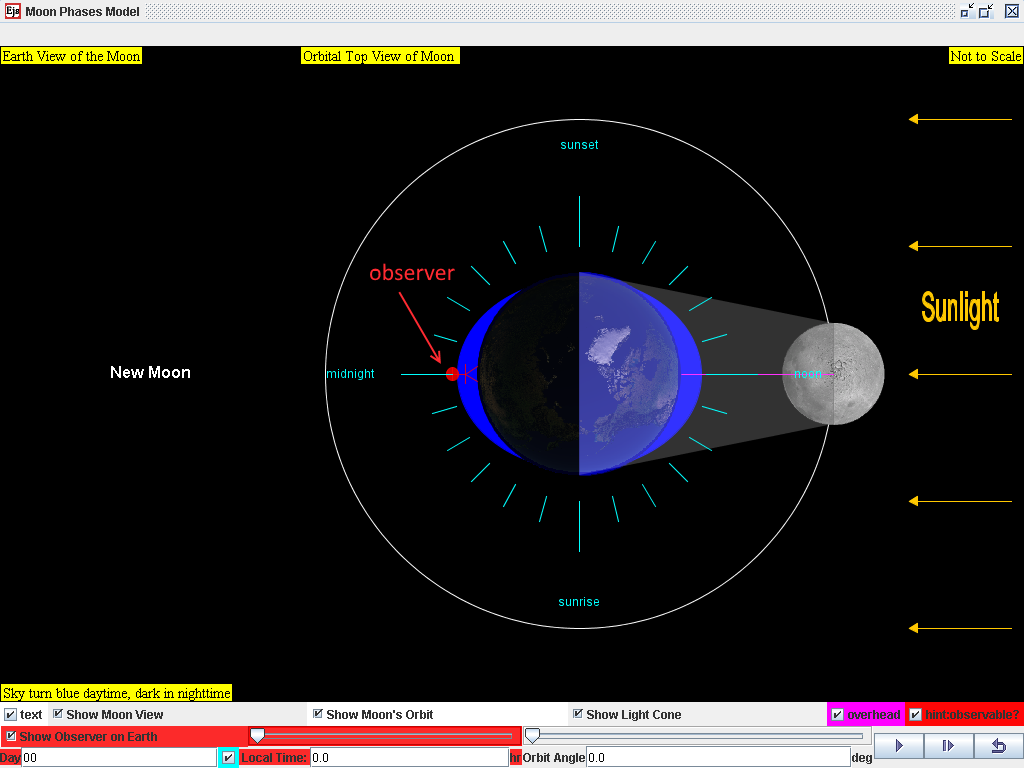
On Day 0, approximately twice a month, around new moon when the Sun, Moon, and Earth form a line (a condition known as syzygy), the tidal force due to the sun reinforces that due to the Moon.
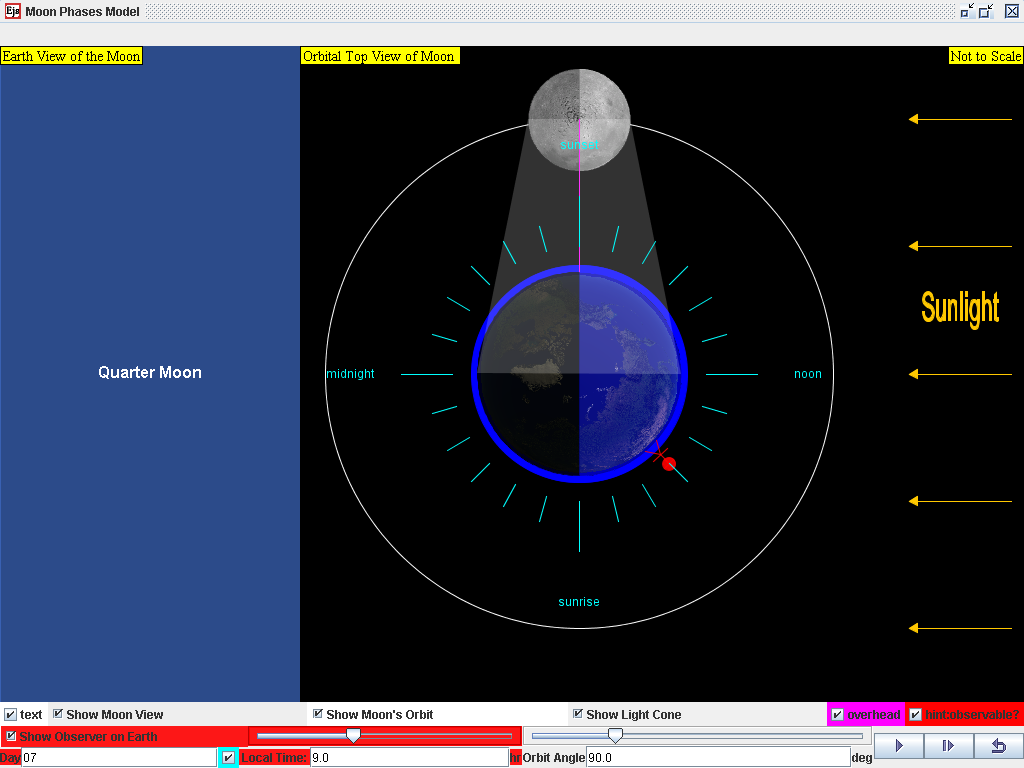

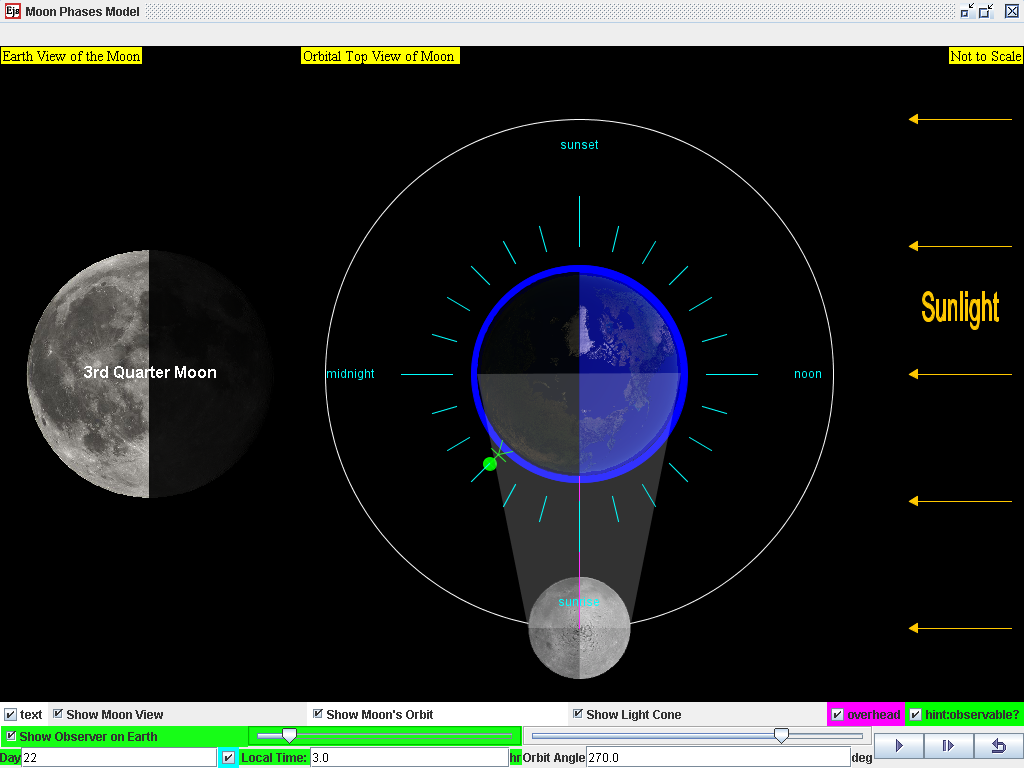
The java required model download here https://dl.dropboxusercontent.com/u/44365627/lookangEJSworkspace/lookangejss/02_newtonianmechanics_7gravity/ejs/ejs_model_MoonPhases.jar
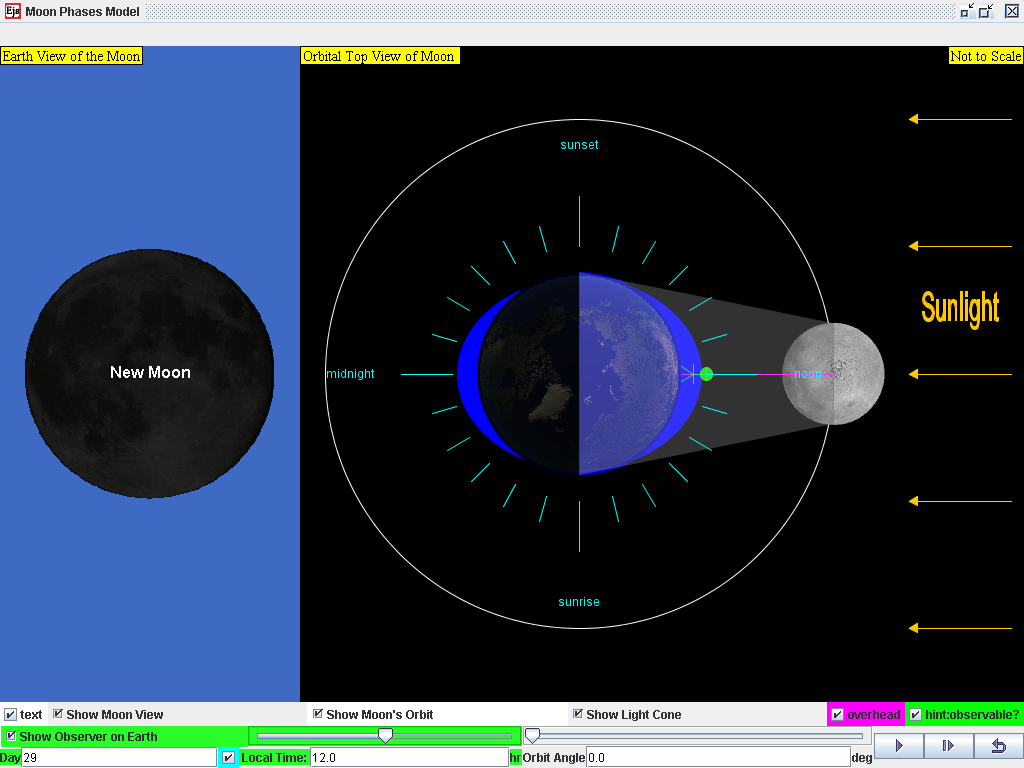
At the end of the lunar cycle on the Day 29, 12 hours, around new moon when the Sun, Moon, and Earth form a line (a condition known as syzygy), the tidal force due to the sun reinforces that due to the Moon.
The falling of objects when released is also caused by the gravitational pull of the Earth on all objects. In terms of planetary motion, gravitational force is responsible for keeping the Earth in its orbit around the Sun, which in turns gives rise to four seasons in some countries.
Gravitation is a natural phenomenon by which physical bodies attract
each other due to their masses. This force occurs whenever masses are
present and the two bodies need not to be in contact with each other. It
is however the weakest of the fundamental forces of nature.
In 1687, Sir Isaac Newton concluded that this non-contact gravitational
force must be as responsible for the falling of the apple from a tree as
it is the cause for the rotation of the moon about the earth. Hence he
published the Newton’s law of gravitation which states that:
“The mutual force of attraction between any two point masses is
directly proportional to the product of their masses and
inversely proportional to the square of the separation between their
centres.”
This means that if there are two point masses M and m and they are separated by distance r, the magnitude of the gravitational force attracting them to each other is
where G, the constant of universal gravitation, is (will be given in data & formulae list during tests and examinations).
Note:
1. r is taken
to be the centre to centre distance (i.e. centre of particle to centre of
particle). Do not take r to be the radius of orbit!
2. This formula is an example of the inverse square law.
The two forces in the diagram are action-reaction pair because each force
is acting on the particle by the other particle.
You did! But the mass of Earth is relatively much bigger than my mass and hence its acceleration is relative much smaller.
Estimate the gravitational force exerted between you and your nearest neighbour in this lecture theatre.
Assume that both masses are 100 kg
each and the distance between the centres of gravity of the two persons is
1.00 m.
Magnitude of the force = = = 6.67 x 10⁻⁷ N
(Note: This force is really small)
3) using the model, design an inquiry approach for asking the question: is the relationship of the force on mass 1 due to mass 2, |F1| and mass 2 due to mass 1 |F2| on each other and their centre to centre distances apart r ?
(hints: ask the question: is the relationship of the force on mass 1 due to mass 2, |F1| and mass 2 due to mass 1 |F2| on each other and their centre to centre distances apart r ? is the model |F| = GmM/r2 valid?, plan what are the variables needed to test this model? collect the appropriate data, analyze the data, explain the data, argue with the evidences your understanding, communicate the result)