From five-minute demonstration to investigable model
The real homopolar motor is delightfully economical: a battery supplies the potential difference, a conducting magnet completes the circuit, and a shaped copper wire becomes the rotating element. Yet the demonstration can finish before students have had time to locate the circuit or reason about the direction of the magnetic force.
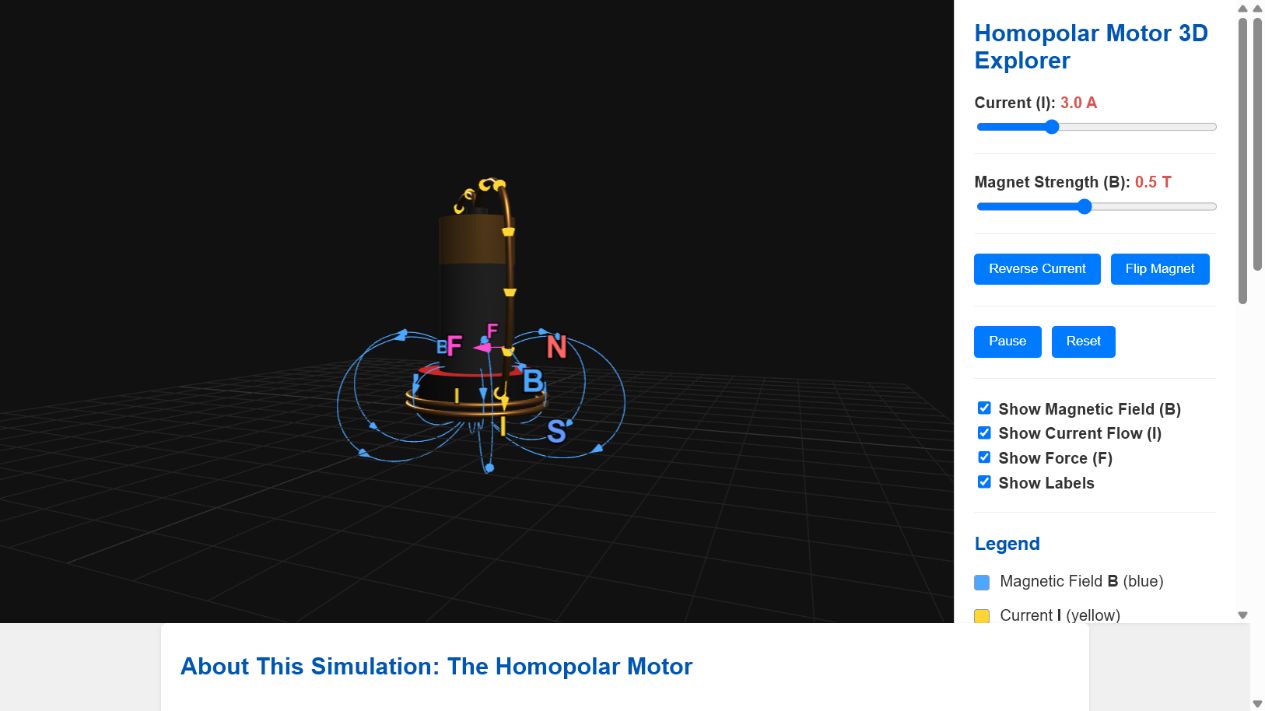
This explorer slows down the reasoning. Learners can orbit the apparatus, pause the rotation, isolate the vector overlays, reverse the current, flip the magnet and compare their prediction with the model.
Seeing the invisible triad
The magnetic field is shown as smooth blue loops. These represent the global field structure: outside the magnet, field lines leave the north pole and return to the south pole. Near the rim, the local field contains the radial component that matters for the motor effect.
Yellow markers follow conventional current along both wire arms. Magenta force arrows are computed from the local current and field directions. The three colours make a spatial relationship visible that is difficult to communicate using a flat left-hand-rule diagram.
Force direction follows the vector relationship between current and magnetic field; the conductor length L scales its magnitude.
A model with dynamics, not only arrows
The turning effect accelerates the wire until the driving magnetic torque is balanced by the model's frictional torque. Increasing current or magnet strength raises the force and the steady angular speed. Setting current to zero removes the driving torque, but rotational inertia allows the wire to coast briefly before friction stops it.
This creates a useful bridge from the motor effect to rotational dynamics: force produces torque, torque changes angular speed, and resistive effects determine the eventual steady motion.
Try the Claude Fable 5 explorer
- Pause the motor and identify the complete conducting path.
- Hide I and F. Follow several blue field loops from north to south.
- Restore the vector triad and use the local I and B directions to predict F.
- Reverse only the current, then flip only the magnet.
- Reverse both quantities and explain why the original rotation direction returns.
Five questions for students
Two complementary versions
This Claude Fable 5 explorer is intentionally published as a separate alternate model. It complements the Homopolar Motor Lab, which uses a different interface and field-line presentation. Comparing the two models can itself become a lesson about representation: which display helps you trace the circuit, understand the field or determine the force most clearly?
Credits and open learning
Made by lookang and created using Claude Fable 5 for Open Educational Resources / Open Source Physics @ Singapore. The physical concept was informed by the JavaLab homopolar motor explanation; no source code or page layout was copied.
The complete ZIP package contains the HTML, JavaScript, CSS and localised Three.js libraries for offline use and adaptation.