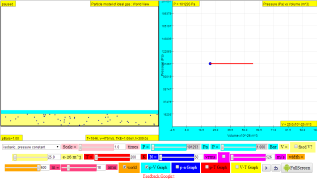
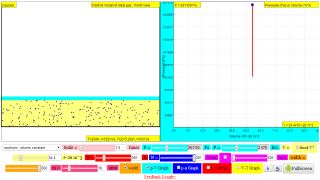
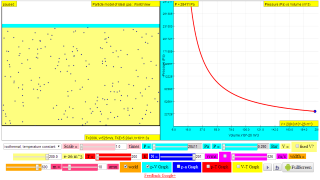
About this Simulation

This simulation models ideal gas behavior by visualizing particle interactions in two dimensions. Learners observe how gas molecules move, collide, and exert pressure on container walls. By adjusting particle number, volume, and temperature in real-time, students explore the relationships between pressure, volume, and temperature that underpin the ideal gas law.

Learning objectives: Understand how molecular motion creates gas pressure | Connect macroscopic gas properties (P, V, T, n) to microscopic particle behavior | Apply kinetic theory principles to explain gas law relationships


Title and author:

Ideal Gas Model based on Kinetic Theory of Gas
Logo Logo Logo

author image author image author image Fu-Kwun Hwang; Francisco (Paco) Esquembre; lookang