Teacher Demonstration
Use the live model as a shared screen demonstration before students try their own predictions and observations.
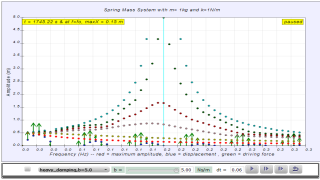
Explore Spring Mass Model With Resonance as an interactive EJS simulation for mechanics.
Use the live model as a shared screen demonstration before students try their own predictions and observations.
Open the simulation, adjust the controls, and compare what changes on screen before answering the concept-check questions.
Which driving frequency produces the largest response, and how does damping affect it?
Observe the response at a low or high driving frequency.
Change the driving frequency in steps and compare amplitude.
Find the frequency range with the largest steady response.
If damping is available, compare how the peak response changes.
Use this to show that timing matters, not only force size. Resonance is about energy transfer at the right frequency.
Ask: What is being driven? Which setting gives the largest amplitude? What happens when damping increases?
Make students record amplitude for several frequencies before naming the resonance condition.
These questions are generated from the topic and the concept illustrated by the simulation. Use them after students have explored the model.
Correct first attempts build a streak and unlock higher point multipliers on this device.
1. What indicates resonance?
2. What should be varied to find resonance?
3. What does damping usually do to resonance?
4. Why is timing important?
5. What evidence should students cite?
Unlocks after 3 correct concept-check answers on this page.
1. In a resonance interactive, what should students compare to identify resonance?
2. What feedback fits 'resonance means the largest force is always applied'?
3. How should damping be included in a resonance explanation if the control is shown?
4. What is the expert use of a resonance graph?
5. What makes a resonance conclusion expert-level?
Anonymous activity shows this resource is being discovered, revisited, and used by learners in different places.
Country or region is inferred anonymously from server location headers when available. No names, accounts, or IP addresses are shown.