Evaporation (Surface Area, Temperature, Humidity, Presence Of Wind) For Woodgrove Prima...
Explore Evaporation (Surface Area, Temperature, Humidity, Presence Of Wind) For Woodgrove Prima... as an interactive EJS simulation for thermal physics.
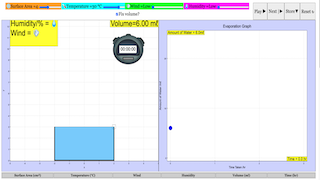
1. Watch or Launch
Launch the Interactive
Open the simulation, adjust the controls, and compare what changes on screen before answering the concept-check questions.
2. Big Ideas
What Students Can Learn
- Treat evaporation as escape of energetic particles from the liquid surface.
- Compare one factor at a time: temperature, surface area, humidity, wind, or pressure.
- Use rate of evaporation as the observed outcome.
- Explain cooling by evaporation where faster particles leave the liquid.
Guiding Question
Which factor is being changed, and how does it affect the rate at which particles leave the liquid surface?
3. Try the Investigation
Predict the Fastest Case
Choose two settings and predict which should evaporate faster before running the model.
Change One Factor
Vary only temperature, surface area, humidity, wind, or pressure while keeping other settings fixed.
Compare Rates
Use the display to decide whether the evaporation rate increases or decreases.
Explain with Particles
Explain the result using surface particles, energy, and the surrounding air conditions.
4. Teacher Notes
Lesson Use
Use this as a fair-test lesson on rate factors. Students should identify the independent variable, dependent variable, and controlled variables before touching the controls.
Discussion Prompts
Ask: Why does wind or lower humidity help evaporation? Why does larger surface area matter? Why can evaporation cool the remaining liquid?
Teaching Moves
Run a contrast pair: high temperature versus low temperature, then high humidity versus low humidity. Ask students to explain each result with particles at the surface.
5. Concept Check
These questions are generated from the topic and the concept illustrated by the simulation. Use them after students have explored the model.
Concept Score
Correct first attempts build a streak and unlock higher point multipliers on this device.
1. What must happen for a liquid particle to evaporate?
2. Which factor usually increases evaporation rate?
3. Why change one factor at a time?
4. What is the dependent variable in an evaporation investigation?
5. What is a useful classroom question?
Expert Challenge
Unlocks after 3 correct concept-check answers on this page.
1. In an evaporation interactive, what particle-level event should students connect to evaporation rate?
2. What fair test should students use for temperature, surface area, humidity, wind, or pressure?
3. Why can evaporation cool the remaining liquid in the model?
4. What feedback fits 'boiling and evaporation are exactly the same event'?
5. What makes an evaporation answer expert-level?
7. Learning Pulse
Anonymous activity shows this resource is being discovered, revisited, and used by learners in different places.
Where Recent Learners Are From
Country or region is inferred anonymously from server location headers when available. No names, accounts, or IP addresses are shown.