Changes Of A Electromagnet'S Polarity
Explore Changes Of A Electromagnet'S Polarity as an interactive EJS simulation for electricity and magnetism.
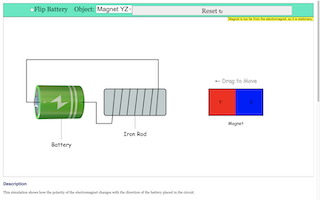
1. Watch or Launch
Launch the Interactive
Open the simulation, adjust the controls, and compare what changes on screen before answering the concept-check questions.
2. Big Ideas
What Students Can Learn
- Read voltage, current, and resistance as separate quantities.
- Use Ohm's law to compare one changed setting at a time.
- Check whether components are connected in series, parallel, or a simpler single-branch circuit.
- Relate current and voltage to power or brightness where shown.
Guiding Question
How do the circuit connection and meter readings explain the change in current, voltage, resistance, or power?
3. Try the Investigation
Trace the Circuit
Find the supply, component, switch, and current path before changing values.
Read the Meters
Record voltage and current readings with units.
Change One Quantity
Alter voltage or resistance while keeping the other setting clear.
Explain with Ohm's Law
Use V, I, and R to explain the observed change.
4. Teacher Notes
Lesson Use
Use this as a quantitative evidence task. Ask students to quote a meter reading before making an Ohm's law claim.
Discussion Prompts
Ask: Which quantity changed? Which quantity was held fixed? How do the readings support V = IR?
Teaching Moves
Use paired cases with only one changed value, then ask students to predict the next reading before checking the model.
5. Concept Check
These questions are generated from the topic and the concept illustrated by the simulation. Use them after students have explored the model.
Concept Score
Correct first attempts build a streak and unlock higher point multipliers on this device.
1. In an Ohm's law or resistor interactive, what should students compare?
2. For the same potential difference, what happens when resistance increases?
3. What does a straight-line V-I graph through the origin suggest for a resistor?
4. What evidence should be cited when a variable resistor is changed?
5. What makes a DC-circuit conclusion strong?
Expert Challenge
Unlocks after 3 correct concept-check answers on this page.
1. In a bar-magnet field-line interactive, what should students use to infer field direction?
2. What feedback fits 'magnetic field lines start at one pole and stop in empty space'?
3. How should students compare two magnets in the model?
4. What should students infer from denser magnetic field lines?
5. What makes a magnetism answer expert-level?
7. Learning Pulse
Anonymous activity shows this resource is being discovered, revisited, and used by learners in different places.
Where Recent Learners Are From
Country or region is inferred anonymously from server location headers when available. No names, accounts, or IP addresses are shown.