Geiger Reader
Explore Geiger Reader as an interactive EJS simulation for modern physics.
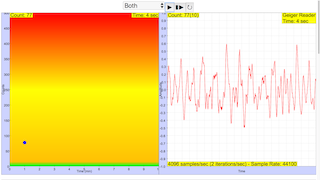
1. Watch or Launch
Launch the Interactive
Open the simulation, adjust the controls, and compare what changes on screen before answering the concept-check questions.
2. Big Ideas
What Students Can Learn
- Connect vertical deflection to voltage using the volts-per-division setting.
- Connect horizontal spacing to time using the time-base setting.
- Measure amplitude and peak-to-peak voltage from the trace.
- Use period from the trace to calculate frequency.
Guiding Question
What does the oscilloscope trace reveal about the signal's voltage, period, frequency, and waveform?
3. Try the Investigation
Identify the Axes
Treat vertical displacement as voltage and horizontal displacement as time, using the scale settings shown by the model.
Set the Controls
Adjust amplitude, frequency, volts-per-division, or time-base controls one at a time so the trace is readable.
Read the Trace
Count divisions for amplitude or peak-to-peak voltage and for one complete cycle.
Calculate and Explain
Convert divisions into voltage and time, then use frequency = 1 / period where appropriate.
4. Teacher Notes
Lesson Use
Use this as a measurement-with-instrument lesson: students should read the oscilloscope trace using scale settings rather than just describe the wave shape.
Discussion Prompts
Ask: What does one vertical division represent? What does one horizontal division represent? How many divisions make one cycle? How would changing the time-base affect the displayed trace?
Teaching Moves
Have students annotate a trace with amplitude, peak-to-peak voltage, and period before calculating frequency. Emphasise that changing display scale changes the drawing, not necessarily the signal itself.
5. Concept Check
These questions are generated from the topic and the concept illustrated by the simulation. Use them after students have explored the model.
Concept Score
Correct first attempts build a streak and unlock higher point multipliers on this device.
1. What does the vertical direction on an oscilloscope trace usually represent?
2. What does the time-base control help you measure?
3. How can frequency be found from the trace?
4. What does peak-to-peak voltage measure?
5. Why should only one control be changed at a time?
Expert Challenge
Unlocks after 3 correct concept-check answers on this page.
1. A trace takes 4 horizontal divisions for one cycle and the time-base is 2 ms per division. What is the period and frequency?
2. A sine trace is 3 divisions above the centre line at its peak with 0.5 V per division. What are the amplitude and peak-to-peak voltage?
3. A student changes the time-base and the trace looks more spread out horizontally. What is the best interpretation?
4. If volts per division is increased while the same signal is displayed, what should usually happen to the trace height?
5. What makes an oscilloscope conclusion expert-level?
7. Learning Pulse
Anonymous activity shows this resource is being discovered, revisited, and used by learners in different places.
Where Recent Learners Are From
Country or region is inferred anonymously from server location headers when available. No names, accounts, or IP addresses are shown.