Transpiration Virtual Lab Factors Affecting Transpiration Virtual Lab (Control Plastic...
Explore Transpiration Virtual Lab Factors Affecting Transpiration Virtual Lab (Control Plastic... as an interactive EJS simulation for biology.
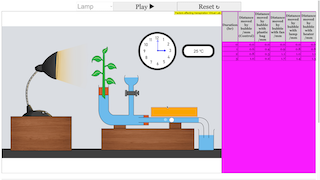
1. Watch or Launch
Launch the Interactive
Open the simulation, adjust the controls, and compare what changes on screen before answering the concept-check questions.
2. Big Ideas
What Students Can Learn
- Recognise oxygen bubbles as evidence of photosynthesis.
- Treat lamp distance as a way to vary light intensity.
- Treat baking soda as a source of carbon dioxide.
- Change one variable at a time to make a fair comparison.
Guiding Question
Which factor is limiting the bubble rate in your test: light intensity, carbon dioxide supply, or something else held constant?
3. Try the Investigation
Predict the Bubble Rate
Start with the lamp close to the plant and a moderate amount of baking soda. Predict whether moving the lamp farther away will increase or decrease oxygen bubbles.
Vary Light Intensity Only
Change the lamp distance while keeping the baking soda amount fixed. Compare bubble production and explain how light intensity affects photosynthesis rate.
Vary Carbon Dioxide Only
Keep the lamp distance fixed, then change the baking soda amount. Use the oxygen bubble count to decide whether carbon dioxide supply is affecting the rate.
Identify a Limiting Factor
Choose two settings with different bubble rates. Decide which factor is limiting photosynthesis in each case and support your claim with what changed on screen.
4. Teacher Notes
Lesson Use
Use this as a fair-test investigation of photosynthesis rate. Ask students to predict bubble production before changing lamp distance or carbon dioxide supply, then use the bubble rate as visible evidence of oxygen production.
Discussion Prompts
Ask: What do the bubbles represent? Why should only one factor be changed at a time? How does moving the lamp affect light intensity? When does adding more carbon dioxide stop increasing the rate?
Teaching Moves
Structure the activity around limiting factors: first hold carbon dioxide steady and vary light, then hold light steady and vary carbon dioxide. Students should name the variable changed, the variable measured, and the controlled conditions.
5. Concept Check
These questions are generated from the topic and the concept illustrated by the simulation. Use them after students have explored the model.
Concept Score
Correct first attempts build a streak and unlock higher point multipliers on this device.
1. In this photosynthesis simulation, what do the oxygen bubbles most directly represent?
2. Why is baking soda used in the setup?
3. What happens to light intensity when the lamp is moved farther away from the plant?
4. Which variables should be changed one at a time for a fair investigation?
5. If the lamp is close enough and carbon dioxide is available, what should students expect to observe?
7. Learning Pulse
Anonymous activity shows this resource is being discovered, revisited, and used by learners in different places.
Where Recent Learners Are From
Country or region is inferred anonymously from server location headers when available. No names, accounts, or IP addresses are shown.