Thinking Aloud Fill Tank X API V 8
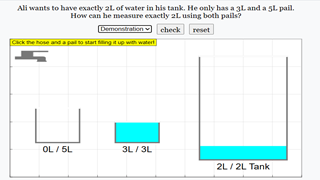
Run Thinking Aloud Fill Tank X API V 8 as a browser-based WebEJS model for mathematics.
1. Watch or Launch
Launch the Interactive
Open the simulation, adjust the controls, and compare what changes on screen before answering the concept-check questions.
2. Big Ideas
What Students Can Learn
- Identify the object or system being analysed.
- Draw or describe the main forces acting on it.
- Use resultant force to predict acceleration.
- Compare the prediction with graph, motion, or numerical evidence.
Guiding Question
Which force or interaction is responsible for the observed change in motion?
3. Try the Investigation
Choose the System
Decide which object or connected objects are being analysed.
Map the Forces
Name the weight, normal reaction, tension, friction, drag, spring force, or contact force involved.
Predict Motion
Use the resultant force to predict acceleration or direction of motion.
Check Evidence
Compare the prediction with the graph, animation, or numerical display.
4. Teacher Notes
Lesson Use
Use the model to practise force reasoning from a force diagram to a motion claim.
Discussion Prompts
Ask: What is the system? Which forces are external? Is the resultant force zero?
Teaching Moves
Require a prediction from forces before running the model, then revise the force diagram if evidence disagrees.
5. Concept Check
These questions are generated from the topic and the concept illustrated by the simulation. Use them after students have explored the model.
Concept Score
Correct first attempts build a streak and unlock higher point multipliers on this device.
1. What is the central question in a dynamics investigation?
2. What does a force diagram help students do?
3. What should be used to predict acceleration?
4. If resultant force is zero, what happens to acceleration?
5. What is a strong final explanation?
Expert Challenge
Unlocks after 3 correct concept-check answers on this page.
1. What is the first expert move in a force problem?
2. What does zero resultant force imply?
3. Why is a force diagram useful before interpreting motion?
4. A student uses speed as evidence for force size. What feedback is strongest?
5. What is a strong final dynamics explanation?
7. Learning Pulse
Anonymous activity shows this resource is being discovered, revisited, and used by learners in different places.
Where Recent Learners Are From
Country or region is inferred anonymously from server location headers when available. No names, accounts, or IP addresses are shown.