https://iwant2study.org/moodle402/mod/laejss/view.php?id=51
https://www.youtube.com/watch?v=pmCtttrscFM {source}<iframe width="560" height="315" src="https://www.youtube.com/embed/pmCtttrscFM?si=_gpN5M5Yy0Ft0yQY" title="YouTube video player" frameborder="0" allow="accelerometer; autoplay; clipboard-write; encrypted-media; gyroscope; picture-in-picture; web-share" referrerpolicy="strict-origin-when-cross-origin" allowfullscreen></iframe>{/source}
{source}
<?php  require_once JPATH_SITE.'/TTcustom/TT_contentparser.php';\(parameters = array("topicname" => "biology", "modelname" => "ejss_model_photosynthesis");echo generateSimHTML(\)parameters, "EJSS");
?>
{/source}
Briefing Document: Factors Affecting Photosynthesis Simulation
{source}<iframe style="border-radius:12px" src="https://open.spotify.com/embed/episode/76YbpDLX7PSd8ora5mFiib?utm_source=generator" width="100%" height="352" frameBorder="0" allowfullscreen="" allow="autoplay; clipboard-write; encrypted-media; fullscreen; picture-in-picture" loading="lazy"></iframe>{/source}
1. Overview:
This document reviews an interactive JavaScript HTML5 applet simulation model designed to teach the factors affecting photosynthesis. The resource is hosted by Open Educational Resources / Open Source Physics @ Singapore. The simulation allows users to manipulate variables like light intensity and carbon dioxide concentration and observe their effects on the rate of photosynthesis, measured by the production of oxygen bubbles. This model is intended to be used as a learning tool for students, and includes activities and questions that guide them through experimentation and data analysis.
2. Core Concepts of Photosynthesis:
- Definition: Photosynthesis is a process used by plants to produce their own food. As stated in the simulation description, "Plants need energy to carry out important life processes like growing. Unlike animals, they do not hunt for food or eat. Instead, plants make their own food through a process called Photosynthesis."
- Location: Photosynthesis occurs in the leaves of the plant.
- Raw Materials and Products: The process uses water and carbon dioxide as raw materials and produces sugar (glucose) as food and oxygen as a byproduct. The simulation notes that "To make food by photosynthesis, plants need water and carbon dioxide as raw materials to make food. Plants also need chlorophyll to trap light energy. the light energy is then used to combine water and carbon dioxide to produce sugar. Oxygen is also released during photosynthesis."
- Chemical Equation: The simulation presents the balanced chemical equation for photosynthesis:
- 6 CO2 + 12 H20 ------------------> C6H12O6 + 6 O2 + 6 H2O
- light
- chlorophyll
- Two Stages: The simulation identifies two stages of photosynthesis:
- Light-dependent stage: "Light energy is absorbed by chlorophyll and converted to chemical energy. Light energy is required to split water molecules into oxygen and hydrogen. (i.e. photolysis of water)"
3. Experimental Design:
The simulation provides two main experiments:
- Experiment 1: Effect of Light Intensity:
- Variable: Light intensity.
- Method: Users adjust a slider to change light intensity, run the simulation, and observe the number of oxygen bubbles produced in one minute.
- Measurement: The number of oxygen bubbles produced indicates the rate of photosynthesis. The simulation notes that, "By measuring the rate at which the bubbles are produced it is possible to tell how fast the plant is photosyntheising (measuring amount of oxygen bubbles produced per minute)."
- Data Collection: Students are directed to record data and generate a graph of number of bubbles vs light intensity.
- Analysis Questions: Questions are provided to help students analyze the relationship between light intensity and the rate of photosynthesis, particularly how the rate changes at higher intensities, with questions like "Describe the graph between 0 and 4 units of light intensity. What does this tell you about the relationship between light intensity and the rate of photosynthesis between 0 and 4 units of light intensity? ... What does this tell you about the relationship between light intensity and the rate of photosynthesis when the light intensity is more than 4 units?".
- Experiment 2: Effect of Carbon Dioxide Concentration:
- Variable: Percentage of dissolved carbon dioxide in water.
- Method: Users adjust a slider to change carbon dioxide levels, run the simulation, and observe the number of oxygen bubbles produced in one minute.
- Data Collection: Students record data and generate a graph of the number of bubbles vs carbon dioxide percentage.
- Analysis Questions: Questions focus on analyzing the relationship between carbon dioxide concentration and the rate of photosynthesis, with specific questions including "Describe the graph between 0% and 0.15% of carbon dioxide. Between 0% and 0.15% of carbon dioxide, what can you tell about the relationship between carbon dioxide concentration and rate of photosynthesis? ... Describe what happens to the graph after 0.15% carbon dioxide. What does this tell you about the relationship between the carbon dioxide concentration and rate of photosynthesis when carbon dioxide concentration exceeds 0.15%?".
4. Key Findings (Implicit in Questions):
Through the simulation and the analysis questions, students are expected to discover that:
- Light Intensity: The rate of photosynthesis generally increases with light intensity up to a certain point, where it may plateau or even decrease.
- Carbon Dioxide Concentration: The rate of photosynthesis generally increases with carbon dioxide concentration up to a certain point, beyond which it might plateau or decrease.
- Limiting Factors: This activity demonstrates the concept of limiting factors; that both light intensity and carbon dioxide are essential to the rate of photosynthesis, and at some point the rate will be determined by the level of the resource in shortest supply.
5. Practical Considerations:
- Accuracy in Real Labs: The resource acknowledges that it's difficult to obtain accurate readings in a school laboratory setting, raising the question, "It is usually difficult to get accurate readings when this experiment is carried out in a school laboratory. Give one reason why this is so."
- Digital Simulation as Solution: The simulation offers a more controlled and consistent environment for experimentation than may be possible in physical lab settings.
- Suggestions for Improving Experiment: The questions ask, "Suggest one way to overcome the difficulty that you have stated above."
6. Supporting Materials:
- Embedded Simulation: The simulation is embedded in the page using an <iframe> tag, making it easily accessible.
- Video Resources: The simulation resource includes a variety of video resources linked to real-world setup, hands-on demos, and detailed explanations of photosynthesis. This includes "Real Setup Video demo - Photosynthesis and respiration with Cabomba pondweed by Science and Plants for Schools" and "Hands-on Demo Photosynthesis Lab Walkthrough by Bozeman Science."
- Other Resources: It links to various other resources, including other simulations and articles, which provide additional learning opportunities on photosynthesis.
7. Educational Use:
- Learning Goals: The simulation explicitly states its learning goals: "Bubbles are given off by the plant through Photosynthesis. By measuring the rate at which the bubbles are produced it is possible to tell how fast the plant is photosyntheising (measuring amount of oxygen bubbles produced per minute)."
- Teacher Guidance: Instructions and questions for teachers are provided for both activities, "For Teachers" - "Investigate how light intensity affects the rate of photosynthesis" and "Investigate how percentage of dissolved Carbon Dioxide in water affects rate of photosynthesis."
- Data Analysis: The simulation emphasizes data collection, graph plotting, and interpreting results, which are essential scientific skills.
8. Technical Details:
- JavaScript HTML5: The simulation is built using JavaScript and HTML5, making it accessible on various devices without requiring special plugins.
- Open Educational Resource: The resource is freely available for educational purposes under a Creative Commons license, promoting sharing and adaptation.
9. Conclusion:
This interactive simulation provides a valuable tool for teaching the fundamentals of photosynthesis and the factors influencing its rate. By using a virtual lab environment, students can easily manipulate key variables, collect and analyze data, and draw conclusions about the process. The included questions and supporting videos enhance the learning experience and promote critical thinking. The resource serves as a good illustration of how technology can facilitate science education.
Photosynthesis Study Guide
Quiz
Instructions: Answer the following questions in 2-3 sentences each.
- What is the overall purpose of photosynthesis for plants?
- What are the two raw materials that plants require for photosynthesis?
- What is the role of chlorophyll in the process of photosynthesis?
- Write the balanced chemical equation for photosynthesis using both chemical formulas and words.
- Describe the two stages of photosynthesis, light-dependent and light-independent.
- According to the simulation, how does increasing light intensity affect the rate of photosynthesis?
- What is the gas given off by plants during photosynthesis?
- Explain the term “limiting factor” in the context of photosynthesis.
- Based on the simulation, what happens to the rate of photosynthesis when the carbon dioxide concentration exceeds 0.15%?
- Besides light intensity and carbon dioxide concentration, what other factor influences photosynthesis?
Answer Key
- The overall purpose of photosynthesis for plants is to create their own food, in the form of sugar (glucose), to provide energy for growth and other life processes. Unlike animals, they do not consume food, but rather produce their own.
- The two raw materials that plants require for photosynthesis are water (H2O), which is typically absorbed through the roots, and carbon dioxide (CO2), which is taken in from the air through small openings in the leaves called stomata.
- Chlorophyll is a pigment found in the chloroplasts of plant cells, and its crucial role is to absorb light energy, particularly from the sun. This light energy is then used to power the process of photosynthesis.
- The balanced chemical equation for photosynthesis is: 6 CO2 + 12 H2O → C6H12O6 + 6 O2 + 6 H2O. This can be stated in words as: Six molecules of carbon dioxide plus twelve molecules of water, in the presence of light and chlorophyll, yields one molecule of glucose, six molecules of oxygen, and six molecules of water.
- The light-dependent stage of photosynthesis involves the absorption of light energy by chlorophyll and the conversion of this energy into chemical energy. It also includes the splitting of water molecules, producing oxygen and hydrogen ions. The light-independent stage uses the chemical energy produced in the first stage to convert carbon dioxide into sugar.
- According to the simulation, increasing light intensity initially increases the rate of photosynthesis as evidenced by the production of more oxygen bubbles. However, at higher intensities, the rate plateaus, indicating that light intensity is not the only factor that impacts the rate of photosynthesis.
- The gas given off by plants during photosynthesis is oxygen (O2). This is a byproduct of the light-dependent stage where water molecules are split and the oxygen is then released into the atmosphere.
- In the context of photosynthesis, a limiting factor is a condition or resource that, when in short supply, restricts the rate of the process, regardless of the abundance of other necessary resources. For example, if carbon dioxide is limited, the rate of photosynthesis will be slower, even with abundant light.
- Based on the simulation, the rate of photosynthesis increases up to 0.15% carbon dioxide concentration. Beyond this point, the rate of photosynthesis no longer increases and tends to plateau indicating carbon dioxide is no longer the limiting factor.
- While the simulation focused on light intensity and carbon dioxide concentration, other factors influencing photosynthesis include temperature, water availability, and the amount of chlorophyll present in the plant's leaves.
Essay Questions
Instructions: Write a well-organized essay to address each of the following prompts.
- Describe the two stages of photosynthesis, including the inputs, outputs, and importance of each stage. Explain how these two stages work together to achieve the overall goal of photosynthesis.
- Analyze the simulation data and explain the relationship between light intensity and the rate of photosynthesis. Discuss the concept of limiting factors and how it relates to the simulation results.
- Discuss the role of carbon dioxide in photosynthesis. Explain the effect of changing carbon dioxide concentrations on the rate of photosynthesis based on the simulation.
- Compare and contrast the effect of light intensity and carbon dioxide concentration as limiting factors on photosynthesis. Discuss how one may become the most significant factor under various environmental conditions.
- Considering the limitations of the simulation, describe any factors that influence photosynthesis that were not examined. Explain why these other factors are important and how they might affect the overall process of photosynthesis.
Glossary
- Photosynthesis: The process by which plants and other organisms convert light energy into chemical energy, typically using carbon dioxide and water to produce glucose and oxygen.
- Chlorophyll: A green pigment found in plants that absorbs light energy needed for photosynthesis.
- Light-Dependent Stage: The first stage of photosynthesis in which light energy is absorbed and converted to chemical energy, and water molecules are split to release oxygen.
- Light-Independent Stage: The second stage of photosynthesis in which chemical energy from the light-dependent stage is used to convert carbon dioxide into glucose. Also called the Calvin Cycle.
- Glucose: A simple sugar that is produced during photosynthesis and serves as a primary energy source for plants.
- Carbon Dioxide (CO2): A gas that is essential for photosynthesis. It is taken in by plants through the stomata in their leaves.
- Water (H2O): A key ingredient for photosynthesis; absorbed through the roots and used as a source of hydrogen for sugar production.
- Oxygen (O2): A gas produced as a byproduct of photosynthesis and released into the atmosphere.
- Light Intensity: The amount of light energy available to a plant for photosynthesis.
- Rate of Photosynthesis: The speed at which photosynthesis occurs, typically measured by the amount of oxygen produced or carbon dioxide consumed per unit of time.
- Limiting Factor: A resource or environmental condition that restricts the rate of a process when it is in short supply, even if other necessary resources are abundant.
- Photolysis: The process of splitting water molecules using light energy during the light-dependent reactions of photosynthesis.
Sample Learning Goals

Bubbles are given off by the plant through Photosynthesis. By measuring the rate at which the bubbles are produced it is possible to tell how fast the plant is photosyntheising (measuring amount of oxygen bubbles produced per minute).
Expt 1:light intensity affects the rate of photosynthesis
Expt 2: percentage of dissolved Carbon Dioxide in water affects rate of photosynthesis
Plants need energy to carry out important life processes like growing. Unlike animals, they do not hunt for food or eat. Instead, plants make their own food through a process called Photosynthesis. Photosynthesis takes place in the leaves of the plant.
To make food by photosynthesis, plants need water and carbon dioxide as raw materials to make food. Plants also need chlorophyll to trap light energy. the light energy is then used to combine water and carbon dioxide to produce sugar. Oxygen is also released during photosynthesis.
chlorophyll
Water + Carbon Dioxide ------------------> Sugar (Glucose) + Oxygen
light

chlorophyll
6 CO2 + 12 H20 ------------------> C6H12O6 + 6 O2 + 6 H2O
light
Photosynthesis occurs in two stages: light-dependent stage and light-independent stage
light-dependent stage:
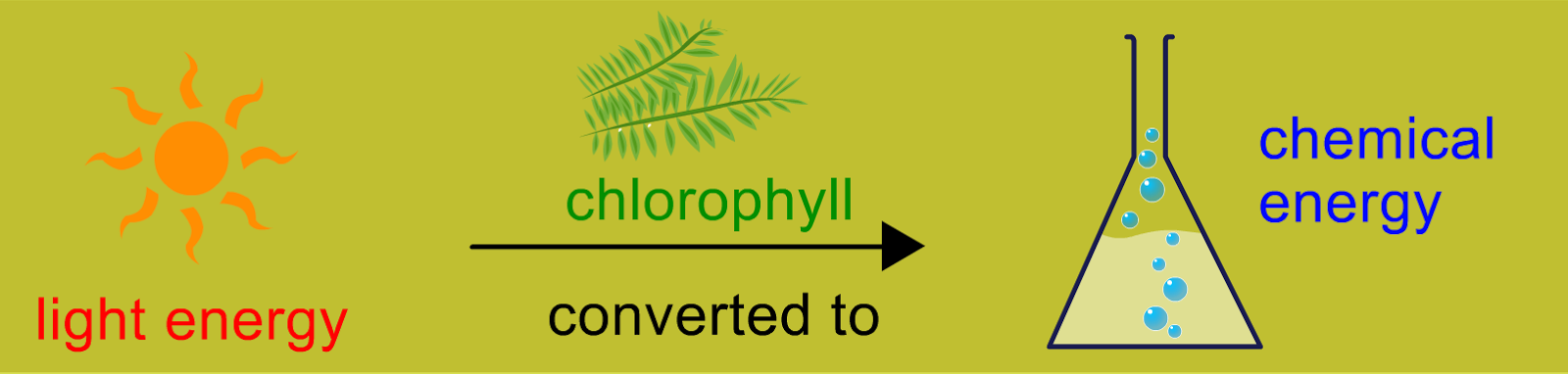
Light energy is absorbed by chlorophyll and converted to chemical energy.
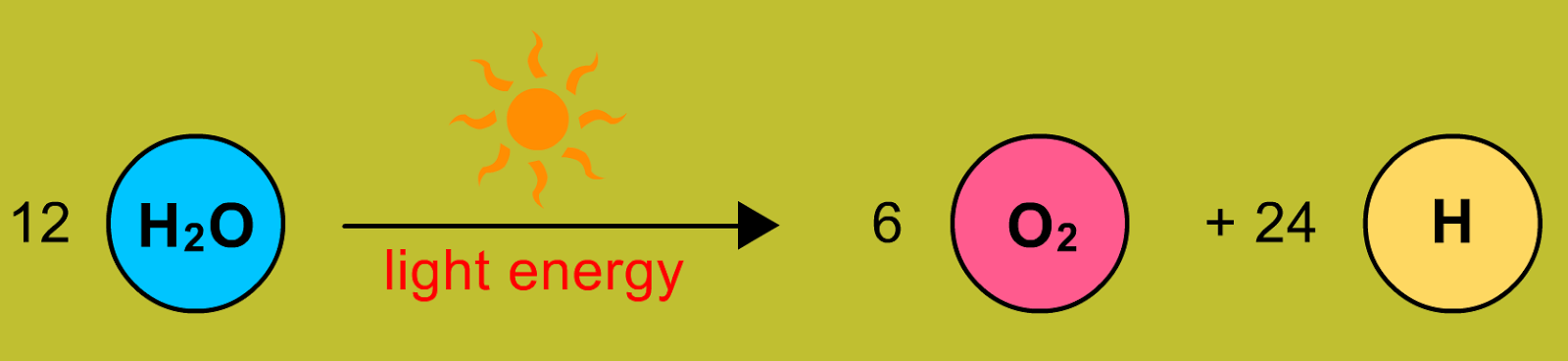
Light energy is required to split water molecules into oxygen and hydrogen. (i.e. photolysis of water)
in summary, 
Activity 1 light intensity affects the rate of photosynthesis
For Teachers
Investigate how light intensity affects the rate of photosynthesis
Investigate how percentage of dissolved Carbon Dioxide in water affects rate of photosynthesis
 |
|
Factors Affecting Photosynthesis JavaScript HTML5 Applet Simulation Model investigate intensity of light vs number of oxygen bubbles |
- Move the slider for Light Intensity to the first unit.
- Click on Start Experiment.
- Observe what happens to the plant and answer the questions below.
-
Questions
- What do you observe at the plant?
- What is the gas that is given out?
______________________________________________________________
- What does the amount of gas given out tell you about the rate of photosynthesis for plant?
______________________________________________________________
______________________________________________________________
- What is the variable in this experiment?
______________________________________________________________
-
Investigating
Instructions
- Move the slider for Light Intensity to the first unit.
- Press Play Experiment and let the experiment run for 1 minute on the stopwatch on the bottom right corner.
- After 1 minute, the total number of bubbles given out by the plant will be shown on the box marked Number of Bubbles on the top right corner of the simulation..
- Click Record to store the data of the Number of Bubbles given out by the plant in 1 minute in the table on the right panel.
- Select the next Light Intensity to the second unit
- Repeat this experiment for units 2 to 6.
- suggested sample data is provided below, please remove it before giving it to the students.
-
Light Intensity / Units Number of Bubbles given out by the plant after 1 minute0 0 1 2 3 4 5 6
Plotting the Graph
Instructions
- Click on Graph option of the dropdown menu.
- The values that you have recorded using the simulation will be automatically plotted, which is the graph of Number of Bubbles against Light Intensity.
- Print out the graph that you have plotted and paste it in the space below.
Questions
- Describe the graph between 0 and 4 units of light intensity.
______________________________________________________________
- What does this tell you about the relationship between light intensity and the rate of photosynthesis between 0 and 4 units of light intensity?
______________________________________________________________
______________________________________________________________
- What does this tell you about the relationship between light intensity and the rate of photosynthesis when the light intensity is more than 4 units?
______________________________________________________________
______________________________________________________________
- It is usually difficult to get accurate readings when this experiment is carried out in a school laboratory. Give one reason why this is so.
______________________________________________________________
______________________________________________________________
- Suggest one way to overcome the difficulty that you have stated above.
______________________________________________________________
______________________________________________________________
Activity 2 percentage of dissolved Carbon Dioxide in water affects rate of photosynthesis
 |
| Photosynthesis JavaScript HTML5 Applet Simulation Model investigate percentage of dissolved carbon dioxide vs number of oxygen bubbles https://sg.iwant2study.org/ospsgx/index.php/573 |
Getting Started
Instructions
- Select Expt 2 on the option on top of the simulation view.
- Move the vertical slider for percentage of carbon dioxide dissolved in the water to 0.05%.
- Click on Play button to start the virtual experiment.
- Observe what happens to the plant and answer the questions below.
Questions
- What do you observe at the plant?
______________________________________________________________
- What is the gas that is given out?
______________________________________________________________
- What does the amount of gas given out tell you about the rate of photosynthesis for plant?
______________________________________________________________
______________________________________________________________
- What is the variable in this experiment?
______________________________________________________________
Investigating
Instructions
- Move the vertical slider for percentage of carbon dioxide dissolved in the water to 0.05%
- Press play button to start the Experiment and let the experiment run for 1 minute on the display on the bottom right corner.
- After 1 minute, the total number of bubbles given out by the plant will be shown on the box on the top right corner marked Number of Bubbles which appears on the top of the plant.
- Click on store data to record the Number of Bubbles given out by the plant in 1 minute in the table on the next page.
- Repeat this experiment for 0.1%, 0.15%, 0.2%, 0.25% and 0.3% of carbon dioxide dissolved in water.
| Percentage of Carbon Dioxide dissolved in the water / % |
Number of Bubbles given out by
the plant after 1 minute
|
| 0.00 | 0 |
| 0.05 | |
| 0.10 | |
| 0.15 | |
| 0.20 | |
| 0.25 | |
| 0.30 |
Plotting the Graph
Instructions
- Click on option on the top dropdown menu to Graph2.
- With the values that you have recorded in the virtual simulator, the plot the graph of Number of Bubbles against Light Intensity as plotted automatically for you.
- Print screen the Graph2 that you have plotted and paste it into the space below.
Questions
- Describe the graph between 0% and 0.15% of carbon dioxide.
______________________________________________________________
- Between 0% and 0.15% of carbon dioxide, what can you tell about the relationship between carbon dioxide concentration and rate of photosynthesis?
______________________________________________________________
______________________________________________________________
- Describe what happens to the graph after 0.15% carbon dioxide.
______________________________________________________________
______________________________________________________________
- What does this tell you about the relationship between the carbon dioxide concentration and rate of photosynthesis when carbon dioxide concentration exceeds 0.15%?
______________________________________________________________
______________________________________________________________
Video
- Real Setup {source}
<iframe width="560" height="315" src="https://www.youtube.com/embed/eIEJ0FfB-VI" frameborder="0" allowfullscreen></iframe>
{/source} Video demo - Photosynthesis and respiration with Cabomba pondweed by Science and Plants for Schools - Hands-on Demo {source}<iframe width="560" height="315" src="https://www.youtube.com/embed/ZnY9_wMZZWI" frameborder="0" allowfullscreen></iframe>
{/source} Photosynthesis Lab Walkthrough by Bozeman Science - Explanation walk through {source}<iframe width="560" height="315" src="https://www.youtube.com/embed/2YABZiYkEuQ" frameborder="0" allowfullscreen></iframe>{/source} IGCSE 2.10. Rate limiting factors in photosynthesis. Ms Cooper by Ms Cooper's IGCSE Biology
- https://www.youtube.com/watch?v=hITp-60mqzg Effect of a Varying Light Intensity on Rate of Photosynthesis-Updated by Biology Bugbears
Version:
Other Resources
- https://www.reading.ac.uk/virtualexperiments/ves/preloader-photosynthesis-full.html
- https://ggbm.at/sAhqyWrS by Vincent lew
- https://www.globalcitizen.org/en/content/bionic-leaf-turn-sunlight-into-fuel/
- https://www.geogebra.org/m/sAhqyWrS
- https://iwant2study.org/lookangejss/biology/ai/riazSulaimi/photosynthesis_bubble_sim_moving_lamp_glow.html by riazSulaimi
Frequently Asked Questions about Photosynthesis
- What is photosynthesis and why is it important for plants?
- Photosynthesis is the process by which plants create their own food. They use water, carbon dioxide, and light energy, which is trapped by chlorophyll, to produce sugar (glucose) for energy and growth. Oxygen is also released as a byproduct of this process. It is crucial for plant survival as it provides the energy they need for essential life functions, like growth.
- What are the two main stages of photosynthesis?
- Photosynthesis occurs in two main stages: the light-dependent stage and the light-independent stage. In the light-dependent stage, light energy is captured by chlorophyll and converted into chemical energy. This stage also involves the splitting of water molecules into hydrogen and oxygen. The light-independent stage uses the chemical energy from the first stage to convert carbon dioxide into glucose.
- How does light intensity affect the rate of photosynthesis?
- Generally, as light intensity increases, the rate of photosynthesis also increases, because light is a critical factor in the light dependent stage. This means that more oxygen is produced, which can be observed by the rate at which oxygen bubbles are produced by a plant. However, there's a limit, where increasing light intensity beyond a certain point no longer increases the rate of photosynthesis. This is because the plant reaches a saturation point where other factors become limiting. In this simulation, we see that the rate of photosynthesis increases dramatically from 0 to 4 units of light, but slows beyond 4 units.
- How does the concentration of dissolved carbon dioxide in water affect the rate of photosynthesis?
- Similar to light intensity, increasing the concentration of dissolved carbon dioxide in water generally increases the rate of photosynthesis. This is because carbon dioxide is a key ingredient in the process of creating sugar. There's also a limit here; the rate of photosynthesis will increase up to a certain point (0.15% in this simulation), but after that point, increasing the carbon dioxide concentration will not continue to increase photosynthesis as another factor becomes limiting, resulting in a leveling off of the rate of photosynthesis.
- What gas is given off during photosynthesis, and how can it be measured?
- The gas produced during photosynthesis is oxygen. The rate of photosynthesis can be estimated by measuring the rate at which oxygen bubbles are produced by a plant. This method is particularly useful for visual demonstrations of the relationship between various factors and the rate of photosynthesis, for example the simulations referenced here.
- Why might it be difficult to get accurate readings when conducting a real photosynthesis experiment in a school laboratory?
- There are many challenges to a live experiment. Difficulties in a school lab can arise from inconsistent lighting, varying temperatures, imprecise measurements of gas volume, variability in plant health, as well as user error in the recording of data. These factors all contribute to potential inaccuracies in the experimental results.
- How can one improve the accuracy of a photosynthesis experiment conducted in a school laboratory?
- To improve accuracy, it is essential to control as many variables as possible, for example, maintain a consistent light source, regulate the temperature, use calibrated measuring equipment, use plants from the same source, and conduct multiple trials to average out errors. Using digital simulation models that are well designed is an excellent way to eliminate many sources of error inherent in a live experiment while still exploring the effects of the various variables.
- Beyond light and carbon dioxide, are there any other factors that influence the rate of photosynthesis?
- Yes, factors such as temperature, the availability of water, the concentration of chlorophyll in the leaves, and the availability of nutrients can all affect the rate of photosynthesis. These factors are typically held constant in the simulations used here, but can be the focus of other studies. In a real-world environment, these limiting factors become very important.