{source}
<?php  require_once JPATH_SITE.'/TTcustom/TT_contentparser.php';\(parameters = array("topicname" => "06QuantumPhysics", "modelname" => "webejs_model_Michelson_Interferometer_Model");echo generateSimHTML(\)parameters, "EJSS");
?>
{/source}
{source}
<?php require_once JPATH_SITE.'/TTcustom/TT_contentparser.php';\(parameters = array("topicname" => "06QuantumPhysics", "modelname" => "ejss_model_michelsoninterferometer");echo generateSimHTML(\)parameters, "EJSS");
?>
{/source}
Briefing Document: Michelson Interferometer JavaScript Simulation Applet HTML5
This document summarizes the key aspects of the "Michelson Interferometer JavaScript Simulation Applet HTML5" resource, focusing on its purpose, functionality, educational value, and applications.
{source}<iframe style="border-radius:12px" src="https://open.spotify.com/embed/episode/6b5jPd2QiWXEBLBFCaBsjc?utm_source=generator" width="100%" height="352" frameBorder="0" allowfullscreen="" allow="autoplay; clipboard-write; encrypted-media; fullscreen; picture-in-picture" loading="lazy"></iframe>{/source}
Main Themes:
- Interactive Learning of Wave Interference: The primary theme revolves around using an interactive JavaScript simulation to visualize and understand the principles of light interference, particularly as demonstrated by the Michelson Interferometer.
- Educational Tool for Physics: The applet serves as a valuable educational resource for students and teachers to explore concepts related to wave behavior, constructive and destructive interference, and the practical applications of interferometry.
- Simulation of a Key Scientific Instrument: The resource focuses on providing a virtual, interactive model of the Michelson Interferometer, a historically significant device that played a crucial role in understanding the nature of light and space-time.
- Application in Various Fields: The material highlights the broad applicability of Michelson Interferometers in metrology, astronomy, seismology, and gravitational wave detection (LIGO).
Most Important Ideas and Facts:
- The Michelson Interferometer:Invented by Albert A. Michelson in the late 19th century.
- Used in the Michelson-Morley experiment.
- "The device splits a beam of light into two paths, reflects the beams back, and then recombines them."
- Interference patterns are created based on path length differences between the two beams.
- Simulation Functionality:The JavaScript/HTML5 applet allows users to interact with a virtual interferometer.
- Key components include:
- Light Source (coherent light waves)
- Half-Silvered Mirror (beam splitter)
- Adjustable Mirrors (manipulate path lengths)
- Detector (observes interference patterns)
- Users can adjust mirror positions and observe real-time changes in the interference pattern.
- Interference Patterns:"When the path difference is an integer multiple of the wavelength, the waves align perfectly, and bright fringes appear on the detector. This is Constructive Interference"
- "When the path difference is an odd multiple of half the wavelength, the waves cancel each other out, creating dark fringes. This is Destructive Interference"
- Educational Benefits:"Visualizing Interference: Seeing interference in action helps demystify how light behaves in an interferometer."
- "Understanding Wave Behavior: By representing light as waves, the applet shows how waves combine and interfere based on their relative phase."
- "Experimenting with Variables: The adjustable controls allow users to experiment with different setups, exploring how changes in mirror position or wave properties affect the result."
- Practical Applications:Metrology: "Precision measurement of distances and lengths."
- Astronomy: "Measurement of stellar diameters and distances."
- Seismology: "Detection of minute shifts in the Earth’s crust."
- Gravitational Wave Detection: As used by "LIGO, which was used to detect gravitational waves."
Key Quotes:
- "The Michelson Interferometer is one of the most important devices in the history of physics, playing a central role in experiments that revolutionized our understanding of light, space, and time."
- "This Michelson Interferometer JavaScript Simulation Applet allows users to interact with a virtual interferometer, replicating real-world experiments in a controlled digital environment."
- "By experimenting with mirror positions and observing real-time changes in interference patterns, users can gain a deeper understanding of one of the most significant devices in the history of physics."
Michelson Interferometer Study Guide
Quiz
Answer the following questions in 2-3 sentences each.
- What is the primary function of a Michelson interferometer?
- Who invented the Michelson interferometer, and what famous experiment was it used in?
- Describe the role of the half-silvered mirror in the Michelson interferometer.
- Explain how adjusting the mirrors in the Michelson interferometer affects the interference pattern.
- What is constructive interference, and how does it manifest in the Michelson interferometer?
- What is destructive interference, and how does it manifest in the Michelson interferometer?
- List three real-world applications of the Michelson interferometer.
- How does the simulation applet allow users to visualize interference patterns?
- What wave property is represented by the visual in the applet?
- Explain how the Michelson Interferometer is used to create interference patterns.
Quiz Answer Key
- The primary function of a Michelson interferometer is to split a beam of light into two paths, reflect them back, and then recombine them to create interference patterns. These patterns can then be analyzed to make very precise measurements.
- Albert A. Michelson invented the Michelson interferometer. It was famously used in the Michelson-Morley experiment, which sought to detect the luminiferous ether.
- The half-silvered mirror in the Michelson interferometer splits the incoming light beam into two beams. Half of the light passes through the mirror, and the other half is reflected at a 90-degree angle, creating the two separate paths for the light to travel.
- Adjusting the mirrors changes the path length of the two light beams, leading to different phase differences when they recombine. These changes directly affect the resulting interference pattern, causing shifts between constructive and destructive interference.
- Constructive interference occurs when the path difference between the two light beams is an integer multiple of the wavelength, causing the waves to align and amplify each other. This results in bright fringes appearing at the detector.
- Destructive interference occurs when the path difference between the two light beams is an odd multiple of half the wavelength, causing the waves to cancel each other out. This results in dark fringes appearing at the detector.
- Three real-world applications of the Michelson interferometer include precision metrology (distance measurement), astronomy (stellar diameter measurement), and seismology (detecting shifts in the Earth’s crust).
- The simulation applet visualizes interference patterns by displaying sinusoidal waves that represent the light beams. Users can observe how the waves combine and interfere based on their relative phase, resulting in distinct fringe patterns.
- The applet is used to visually represent light as waves to demonstrate constructive and destructive interference based on the relative phase.
- By splitting a light beam, reflecting it, and recombining it with varying path lengths, the Michelson Interferometer creates interference patterns that are then observed at the detector.
Essay Questions
- Discuss the significance of the Michelson-Morley experiment and how the Michelson interferometer was instrumental in its execution and results.
- Explain the concepts of constructive and destructive interference in detail, providing examples of how these phenomena are demonstrated using the Michelson interferometer simulation.
- Evaluate the educational value of the Michelson interferometer simulation applet, highlighting its effectiveness in teaching abstract concepts related to light and wave behavior.
- Describe the working principles of the Michelson interferometer, emphasizing the roles of the light source, half-silvered mirror, adjustable mirrors, and detector in creating interference patterns.
- Research and discuss current advancements in the applications of interferometry, including the use of Michelson interferometers in modern scientific research and technology.
Glossary of Key Terms
- Michelson Interferometer: An optical instrument that splits a beam of light into two paths, reflects the beams back, and recombines them to produce interference patterns.
- Interference: The phenomenon that occurs when two or more waves superimpose to form a resultant wave of greater, lower, or the same amplitude.
- Constructive Interference: The superposition of waves resulting in an increased amplitude, occurring when the waves are in phase.
- Destructive Interference: The superposition of waves resulting in a decreased amplitude, occurring when the waves are out of phase.
- Wavelength: The distance between successive crests of a wave.
- Half-Silvered Mirror: An optical component that partially reflects and partially transmits a beam of light.
- Path Difference: The difference in the distance traveled by two light beams in an interferometer.
- Fringes: The bright and dark bands observed in an interference pattern.
- Coherent Light: Light waves that have a constant phase relationship, allowing for clear interference patterns.
- Phase Difference: The difference in phase between two waves, determining whether they will constructively or destructively interfere.
- Metrology: The science of measurement.
- Simulation Applet: An interactive computer program that models a real-world phenomenon, allowing users to explore and manipulate variables.
Sample Learning Goals
[text]
For Teachers
Michelson Interferometer JavaScript Simulation Applet HTML5

Instructions on using the Simulation Applet
Drag-able Mirrors


Step 2: Look at the Detector Wave

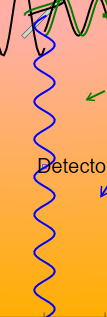
Drag-able arrows


Research
 |
| https://sg.iwant2study.org/ospsgx/index.php/606 link |
Exploring the Michelson Interferometer with a JavaScript Simulation Applet
The Michelson Interferometer is one of the most important devices in the history of physics, playing a central role in experiments that revolutionized our understanding of light, space, and time. Today, you can explore how this device works using a powerful Michelson Interferometer Simulation Applet, built in JavaScript and running on HTML5. This interactive tool helps visualize how light interference patterns are formed and how small differences in distance can lead to profound changes in the behavior of light.
What is the Michelson Interferometer?
The Michelson Interferometer was invented by Albert A. Michelson in the late 19th century and is known for its use in the famous Michelson-Morley experiment. The device splits a beam of light into two paths, reflects the beams back, and then recombines them. As the two light beams travel different distances, they interfere with each other when they meet again, creating a pattern of bright and dark fringes.
These interference patterns depend on:
- The wavelength of the light used,
- The difference in the lengths of the two paths traveled by the beams, and
- The angle of the mirrors in the setup.
How the Simulation Works
This Michelson Interferometer JavaScript Simulation Applet allows users to interact with a virtual interferometer, replicating real-world experiments in a controlled digital environment.
Key features of the applet include:
- Light Source: A source of coherent light, which is represented by sinusoidal waves. The light moves from the source and is split by a half-silvered mirror.
- Half-Silvered Mirror: This element splits the light beam into two paths, with half the light passing through and the other half reflecting at a 90-degree angle.
- Mirrors: The two arms of the interferometer reflect light back using two mirrors (Mirror 1 and Mirror 2). These mirrors can be adjusted to change the distance the light travels.
- Detector: The detector captures the recombined light waves, and based on the phase difference between the two beams, an interference pattern is formed.
Interactive Features
The applet offers various controls and parameters that users can adjust in real-time to see how different configurations affect the interference pattern:
- Position of the mirrors: Adjusting the positions of the mirrors allows users to explore how changing the path length of one of the beams affects the resulting interference pattern.
- Wave properties: The applet uses a visual representation of light as waves, making it easy to see how the phase difference between the two beams leads to constructive and destructive interference.
- Real-time animation: The applet can be paused, stepped forward, or reset, allowing users to slow down and analyze specific stages of the interference process.
Exploring Interference Patterns
The key result of the Michelson Interferometer is the interference pattern created at the detector. The pattern is determined by the path difference between the two beams:
- Constructive Interference: When the path difference is an integer multiple of the wavelength, the waves align perfectly, and bright fringes appear on the detector.
- Destructive Interference: When the path difference is an odd multiple of half the wavelength, the waves cancel each other out, creating dark fringes.
By adjusting the mirrors in the applet, users can explore these patterns and see how even small changes in path length can switch between constructive and destructive interference.
Educational Value of the Applet
This applet provides an accessible way for students and educators to explore the concepts of light interference and the functioning of the Michelson Interferometer. It can be particularly useful for:
- Visualizing Interference: Seeing interference in action helps demystify how light behaves in an interferometer.
- Understanding Wave Behavior: By representing light as waves, the applet shows how waves combine and interfere based on their relative phase.
- Experimenting with Variables: The adjustable controls allow users to experiment with different setups, exploring how changes in mirror position or wave properties affect the result.
Applications of the Michelson Interferometer
The Michelson Interferometer is more than just a historical experiment; it has practical applications in many fields of science and engineering, including:
- Metrology: Precision measurement of distances and lengths.
- Astronomy: Measurement of stellar diameters and distances.
- Seismology: Detection of minute shifts in the Earth’s crust.
- Laser Interferometry: The technology behind LIGO, which was used to detect gravitational waves.
Conclusion
The Michelson Interferometer JavaScript Simulation Applet provides a powerful, interactive way to learn about the principles of interference and light waves. By experimenting with mirror positions and observing real-time changes in interference patterns, users can gain a deeper understanding of one of the most significant devices in the history of physics. Whether you’re a student exploring wave interference for the first time or an educator demonstrating the principles of light, this applet is an invaluable tool.
Start exploring today, and experience the power of the Michelson Interferometer in action!
Video
 |
| https://sg.iwant2study.org/ospsgx/index.php/606 link link2 |
Version:
- https://weelookang.blogspot.com/2024/10/exploring-michelson-interferometer-with.html
- https://vle.learning.moe.edu.sg/moe-library/lesson/view/3ea40c99-dfe8-4c94-b264-980434bba9d9/cover
Other Resources
[text]
FAQ: Michelson Interferometer and its Simulation Applet
What is a Michelson Interferometer and why is it important?
The Michelson Interferometer is a device invented by Albert A. Michelson in the late 19th century. It splits a beam of light into two paths, reflects them back, and then recombines them. This is important because it played a central role in experiments that revolutionized our understanding of light, space, and time, most notably in the Michelson-Morley experiment.
How does a Michelson Interferometer work?
A beam of light is split by a half-silvered mirror into two paths. Each path reflects off a mirror and returns to the half-silvered mirror, where they are recombined. Because the light beams travel different distances, they interfere with each other when they meet, creating an interference pattern. The pattern observed depends on the wavelength of light, path length differences, and the angles of the mirrors.
What components are included in the Michelson Interferometer JavaScript Simulation Applet?
The applet includes a light source, a half-silvered mirror (beam splitter), two adjustable mirrors, and a detector. The light source emits coherent light that is split by the half-silvered mirror. The two mirrors reflect the light back, and the detector captures the recombined waves to display the interference pattern.
How can users interact with the Michelson Interferometer JavaScript Simulation Applet?
Users can interact with the simulation by dragging the mirrors to adjust their positions, effectively changing the path length of the light beams. This allows exploration of how changes in path length affect the resulting interference pattern. The applet also allows users to pause, step forward, or reset the animation.
What is meant by "constructive" and "destructive" interference in the context of the Michelson Interferometer?
Constructive interference occurs when the path difference between the two light beams is an integer multiple of the wavelength. This results in the waves aligning perfectly, leading to bright fringes at the detector. Destructive interference occurs when the path difference is an odd multiple of half the wavelength. In this case, the waves cancel each other out, creating dark fringes at the detector.
What can be learned using the Michelson Interferometer Simulation Applet?
The applet allows users to visualize interference in action, helping to understand how light behaves in an interferometer. It demonstrates how waves combine and interfere based on their relative phase, and users can experiment with different setups to observe how changes in mirror position or wave properties affect the result.
What are some real-world applications of the Michelson Interferometer?
The Michelson Interferometer has various practical applications, including precision measurement of distances and lengths (metrology), measurement of stellar diameters and distances (astronomy), detection of minute shifts in the Earth’s crust (seismology), and as the underlying technology for laser interferometry, such as in the LIGO experiment used to detect gravitational waves.
What is the educational value of the Michelson Interferometer JavaScript Simulation Applet?
The applet offers an accessible way for students and educators to explore the concepts of light interference and the functioning of the Michelson Interferometer. It's valuable for visualizing interference, understanding wave behavior, and experimenting with variables to observe the effects on interference patterns.