Teacher Demonstration
Use the live model as a shared screen demonstration before students try their own predictions and observations.
Explore 3 Exercises as an interactive EJS simulation for electricity and magnetism.
Use the live model as a shared screen demonstration before students try their own predictions and observations.
Open the simulation, adjust the controls, and compare what changes on screen before answering the concept-check questions.
Which node or loop equation does each solved value come from, and how can the interactive evidence confirm it?
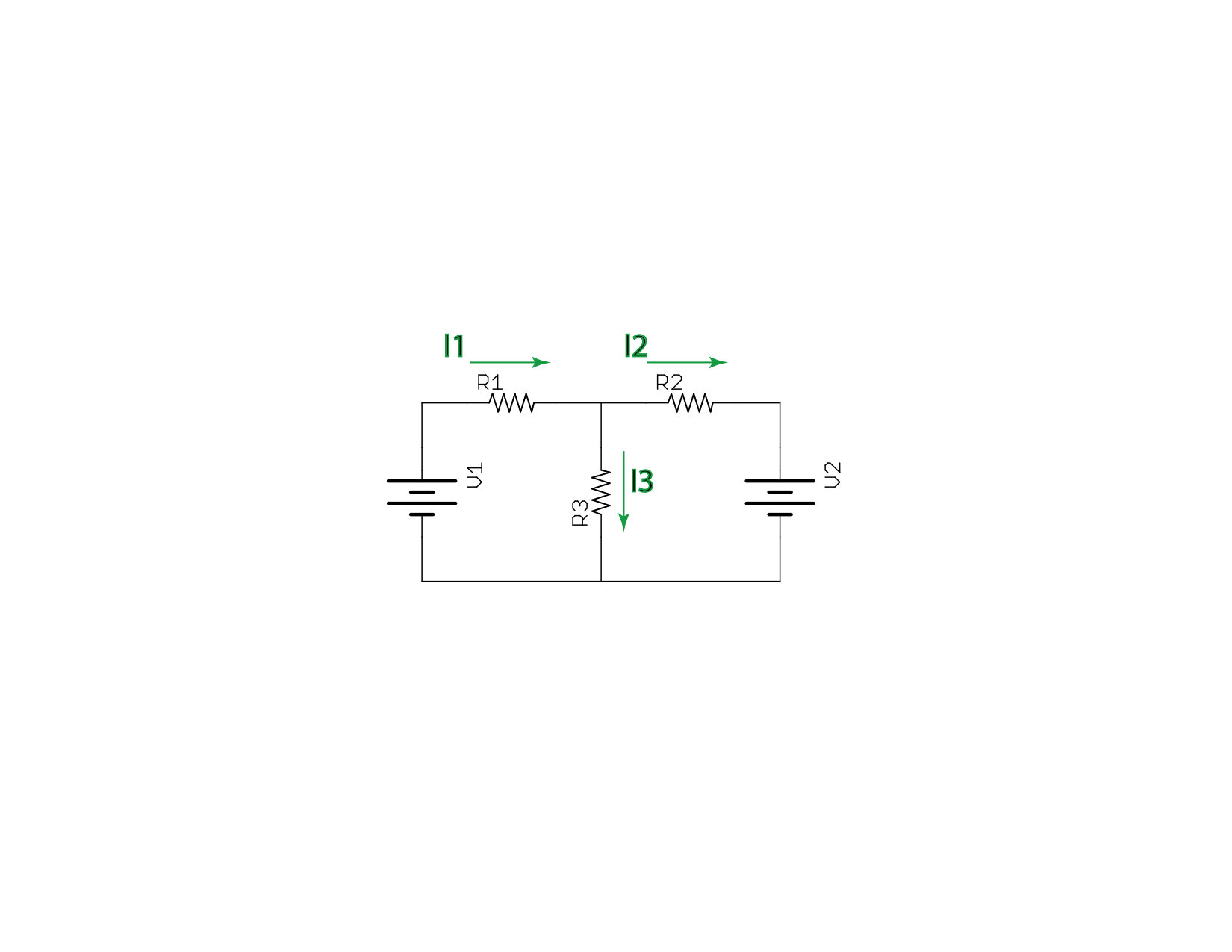
Identify junctions, loops, sources, and resistor labels before solving.
Use Kirchhoff current law for a node or Kirchhoff voltage law for a loop, then connect the signs to chosen current directions.
Use the matrix or numerical solution to read currents and voltages, then compare those values with the circuit diagram or meter display.
Change one resistance or source setting and explain how the affected branch currents and voltage drops change.
Use this as a bridge from circuit diagrams to simultaneous equations. Students should annotate the circuit with current directions, node labels, and voltage drops before accepting the solver output.
Ask: Which equation represents this junction? Which equation represents this loop? What does a negative current mean in the chosen direction? How do the solved values satisfy Ohm's law for each resistor?
Have students predict the sign and relative size of one branch current before running the matrix solver. Then require them to verify the answer with a resistor voltage drop or meter reading.
This profile is used for resistor-network and systems-of-linear-equations pages so the questions do not fall back to generic E&M or magnetism prompts.
These questions are generated from the topic and the concept illustrated by the simulation. Use them after students have explored the model.
Correct first attempts build a streak and unlock higher point multipliers on this device.
1. What should students identify before using the matrix solver on a resistor network?
2. What does Kirchhoff's current law help check at a junction?
3. What does a loop equation usually connect in a resistor network?
4. If the solver gives a negative branch current, what is the best interpretation?
5. What makes a strong final answer for this interactive?
Unlocks after 3 correct concept-check answers on this page.
1. In a resistor-network solver interactive, what should students connect before trusting the matrix answer?
2. What feedback fits 'a negative solved current means the circuit is impossible'?
3. How should students verify a solved branch current?
4. What should a Kirchhoff current law check compare?
5. What makes a resistor-network answer expert-level?
Anonymous activity shows this resource is being discovered, revisited, and used by learners in different places.
Country or region is inferred anonymously from server location headers when available. No names, accounts, or IP addresses are shown.