{source}<iframe width="560" height="315" src="https://www.youtube.com/embed/PYglrq_1hqA?si=_5r84CMT4w_ysmwz" title="YouTube video player" frameborder="0" allow="accelerometer; autoplay; clipboard-write; encrypted-media; gyroscope; picture-in-picture; web-share" referrerpolicy="strict-origin-when-cross-origin" allowfullscreen></iframe>{/source}
{source}
<?php  require_once JPATH_SITE.'/TTcustom/TT_contentparser.php';\(parameters = array("topicname" => "01_measurement", "modelname" => "ejss_model_AAPTVernierCaliper");echo generateSimHTML(\)parameters, "EJSS");
?>
{/source}
podcast https://spotifycreators-web.app.link/e/AL9XUPbVEPb
{source}<iframe style="border-radius:12px" src="https://open.spotify.com/embed/episode/6mqdnFTSeVaNQNoicchmGm?utm_source=generator" width="100%" height="352" frameBorder="0" allowfullscreen="" allow="autoplay; clipboard-write; encrypted-media; fullscreen; picture-in-picture" loading="lazy"></iframe>{/source}
20231003 Update! WEBEJS editor https://macmath.inf.um.es/
Check out Vernier Caliper tape 150mm measures in mm and inch Digital Ruler LCD battery included. Get it on Shopee now! https://shope.ee/2flTsKNmFN?share_channel_code=1
- more worksheet:
 Physics_lab_Sharjah_
University_Tahani_Alsarayreh - Worksheet 📖 ejss_model_Micrometer02 Tahani Ibrahim Ragheb AL Sarayreh physics department :Sharjah University : UAE measurment of density.docx 06 June 2020
- Worksheet 📖 ejss_model_Micrometer02 Tahani Ibrahim Ragheb AL Sarayreh physics department :Sharjah University : UAE measurment of density.pdf 06 June 2020
- Worksheet 📖 :ejss_model_Micrometer02_measurments of density 1 Nawal Nayfeh, Physics instructor at university of sharjah, UAE.pdf 25 May 2020
- Worksheet 📖 :ejss_model_Micrometer02_measurments of density 1 Nawal Nayfeh, Physics instructor at university of sharjah, UAE.docx 20 May 2020
Learnng Objectives https://sites.google.com/moe.edu.sg/a-level-physics-tlg/foundations-of-physics
Errors, uncertainties, precision and accuracy through practical work
Learning Outcomes:
-
H2: 1(f), 1(g)
Curriculum Emphasis:
-
Ways of Thinking and Doing
Can uncertainty be reduced or even eliminated? How do measurement uncertainties propagate to derived quantities?
Identify and discuss how errors and uncertainties arise in specific measurements and experiments that students carry out, and discuss ways to reduce the errors and uncertainties. It is also possible to discuss the concepts of precision and accuracy using the data collected.
This is a way of building on existing practical work throughout the year to reinforce students' understanding of error and uncertainty through experiential learning.
Resources:
Vernier Caliper Study Guide
Quiz
Instructions: Answer the following questions in 2-3 sentences each.
- What are the three types of measurements that can be taken with a vernier caliper?
- Describe the function of the outside jaws on a vernier caliper.
- Explain the purpose of the vernier scale on a vernier caliper.
- What is the typical precision of a vernier caliper used in industry?
- How does the depth probe of a vernier caliper function?
- What is the purpose of the retainer on a vernier caliper?
- What is zero error in the context of vernier calipers, and how does it affect measurements?
- Explain how the main scale and vernier scale work together to provide precise measurements.
- Why is a vernier caliper more precise than a standard ruler?
- List three advantages of using a digital vernier caliper over a traditional analog one.
Quiz Answer Key
- The three types of measurements are: external dimensions, internal dimensions, and depth.
- The outside jaws are used to measure the external dimensions of an object, such as its width or diameter.
- The vernier scale provides a finer level of precision than the main scale, allowing for measurements to be taken to the nearest tenth of a millimeter or even smaller increments.
- Vernier calipers used in industry commonly have a precision of one-hundredth of a millimeter (0.01 mm) or 10 micrometers.
- The depth probe is a thin rod that extends from the caliper body and is used to measure the depth of holes or recesses.
- The retainer is used to lock the movable jaw in place, allowing for the measured dimension to be easily transferred or compared.
- Zero error occurs when the jaws of the caliper are closed but the vernier scale does not align with zero on the main scale. It introduces a systematic error that needs to be accounted for in all measurements.
- The main scale provides the whole millimeter measurement, while the vernier scale determines the fractional part of the millimeter. The vernier scale has markings that are slightly closer together than the main scale, allowing for more precise readings.
- A vernier caliper is more precise because it incorporates a vernier scale that allows for measurements to be taken to fractions of a millimeter. Standard rulers typically only have markings down to the millimeter.
- Advantages of digital calipers: easy to read, no parallax error, can switch between metric and imperial units easily.
Essay Questions
- Discuss the importance of accuracy and precision in scientific measurements. Explain how vernier calipers contribute to achieving accurate and precise measurements.
- Compare and contrast the advantages and disadvantages of vernier calipers and micrometers as precision measuring tools. Provide specific examples where one tool might be preferred over the other.
- Explain how to correctly read a measurement using a vernier caliper. Include a step-by-step guide, addressing the role of the main scale, vernier scale, and zero error.
- Describe various applications of vernier calipers in different fields, such as engineering, manufacturing, and science. Illustrate with examples how the tool's precision is crucial in these specific contexts.
- Explain the concept of zero error in vernier calipers and its impact on measurements. Describe methods to correct for zero error and ensure accurate readings.
Glossary of Key Terms
- Vernier Caliper: A precision measuring instrument used to measure internal and external dimensions, as well as depth, with high accuracy.
- Main Scale: The primary scale on the vernier caliper, graduated in millimeters or inches.
- Vernier Scale: A secondary scale that slides along the main scale, enabling measurements to be taken to fractions of a millimeter or inch.
- Outside Jaws: The larger jaws used to measure external dimensions like width or diameter.
- Inside Jaws: The smaller jaws used to measure internal dimensions, such as the diameter of a hole.
- Depth Probe: A thin rod attached to the caliper, used for measuring depth.
- Retainer: A mechanism to lock the movable jaw in position, facilitating the transfer of measurements.
- Zero Error: An offset in the vernier scale reading when the caliper jaws are fully closed, requiring correction for accurate measurements.
- Precision: The degree of repeatability and consistency in a set of measurements.
- Accuracy: The closeness of a measured value to the true or accepted value.
Briefing Document: Vernier Caliper Simulation
Source: "Vernier Caliper App Full screen version JavaScript HTML5 Applet Simulation Model" from Open Educational Resources / Open Source Physics @ Singapore
Main Theme: The source details a free, interactive, online simulation of a Vernier caliper, designed for educational purposes. The simulation allows students to explore the workings of a Vernier caliper and practice taking accurate measurements in a risk-free virtual environment.
Most Important Ideas and Facts:
- Functionality: The simulation allows users to measure both internal and external dimensions of objects. Users can manipulate the object size and position, introduce zero error, and choose from various Vernier scales. It also includes hints and answers to aid in learning.
- Accessibility: The simulation is built using JavaScript and HTML5, making it accessible on various devices including computers, tablets, and smartphones.
- Educational Goals:Understanding Vernier Caliper Components: The simulation provides a detailed breakdown of the different parts of a Vernier caliper, including the outside and inside jaws, depth probe, main scale, and Vernier scale.
- Accurate Measurement: Students can learn to read the Vernier scale and make precise measurements to the hundredth of a millimeter.
- Zero Error: The simulation allows users to introduce and understand the concept of zero error, a crucial aspect of accurate measurement using a Vernier caliper.
- Learning Outcomes: The simulation is aligned with the learning outcome "(g) describe how to measure a variety of lengths with appropriate accuracy by means of tapes, rules, micrometers and calipers, using a vernier scale as necessary."
- Additional Resources: The source provides links to:
- Research papers discussing the pedagogical benefits of using simulations in conjunction with physical instruments.
- Worksheets developed by educators to accompany the simulation.
- Videos demonstrating the use of both physical and simulated Vernier calipers.
- Mobile apps offering similar Vernier caliper simulations.
Key Quotes:
- "Vernier calipers can measure internal dimensions (using the uppermost jaws in the picture at right), external dimensions using the pictured lower jaws, and depending on the manufacturer, depth measurements by the use of a probe [...] Vernier calipers commonly used in industry provide a precision to a hundredth of a millimetre (10 micrometres)."
- "The Vernier calipers model has an object (Blue) for the internal jaws to measure width of an object with slider to control width of the object and simple drag action to control position of object."
- "checkbox for hint to scaffold the learners attention and point of focus checkbox for answer to show the meaning of reading on the main scale and the vernier scale with zero error calculations if any."
Conclusion:
This online Vernier caliper simulation is a valuable resource for students learning about measurement techniques. Its interactive nature and comprehensive features provide a rich learning experience, making it an effective tool for supplementing traditional classroom instruction.
Apps
{source}
<a href='https://play.google.com/store/apps/details?id=com.ionicframework.vernierapp777926&utm_source=global_co&utm_medium=prtnr&utm_content=Mar2515&utm_campaign=PartBadge&pcampaignid=MKT-Other-global-all-co-prtnr-py-PartBadge-Mar2515-1'><img alt='Get it on Google Play' src='https://play.google.com/intl/en_us/badges/images/generic/en_badge_web_generic.png'/></a>
{/source}

Pro
https://play.google.com/store/apps/details?id=com.ionicframework.vernierpro698620
Free
https://play.google.com/store/apps/details?id=com.ionicframework.vernierapp777926
Free
https://itunes.apple.com/us/app/vernier-calipers-simulator/id1163657388?ls=1&mt=8
Pro
https://itunes.apple.com/us/app/vernier-calipers-simulator-pro/id1244019319?ls=1&mt=8
{source}
<a href="https://itunes.apple.com/us/app/vernier-calipers-simulator/id1163657388?mt=8" style="display:inline-block;overflow:hidden;background:url(https://linkmaker.itunes.apple.com/images/badges/en-us/badge_appstore-lrg.svg) no-repeat;width:165px;height:40px;"></a>
{/source}
How to Use
General Description
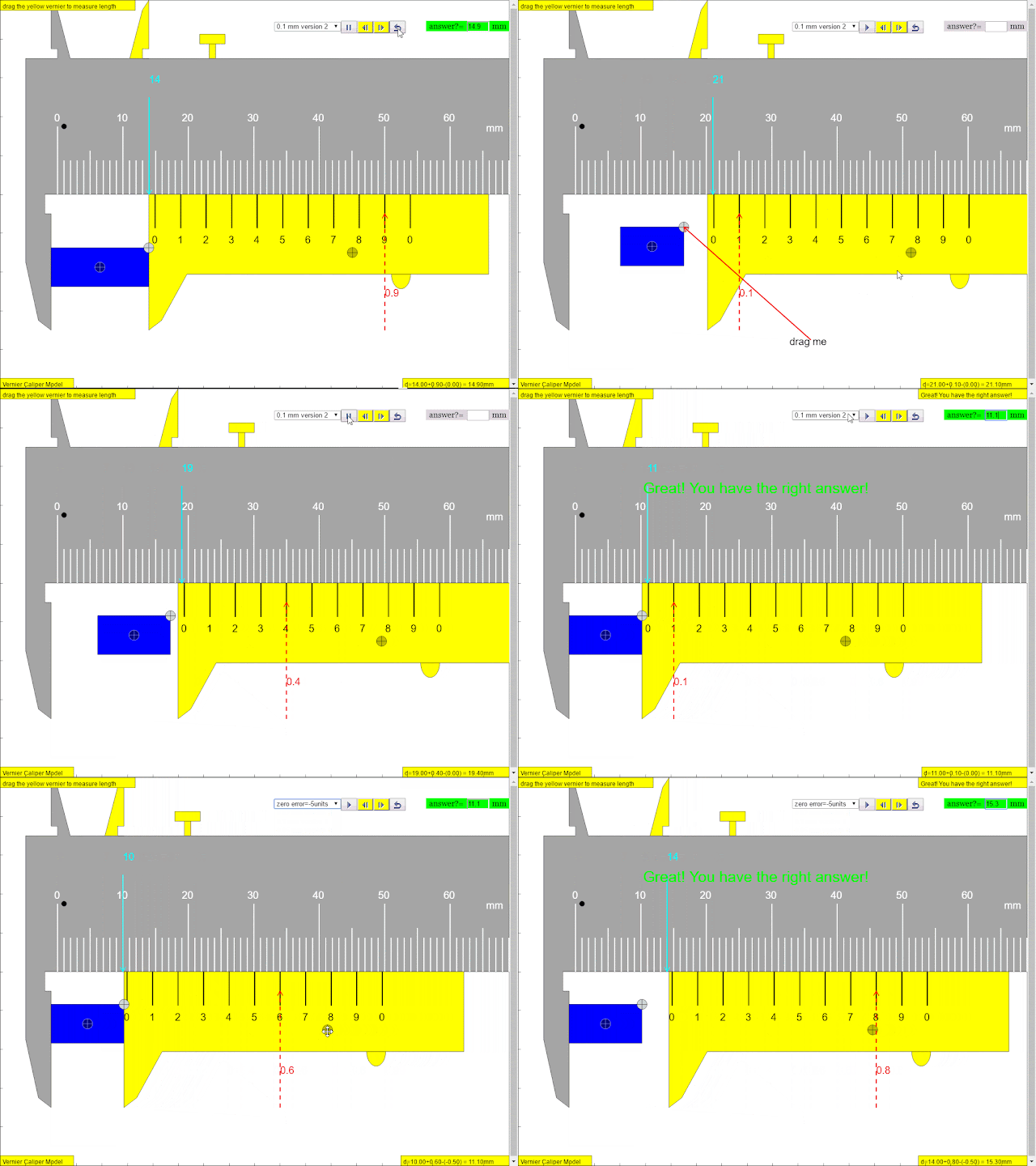
This JavaScript App simulates the Vernier Caliper. The simulation shows the instrument setup with a rectangular object .
The Vernier calipers model has an object (Blue) for the internal jaws to measure width of an object with slider to control width of the object and simple drag action to control position of object.
An object (Green) for external jaws to measure internal diameter of a cylinder for example with slider to control dimensions of the cylinder.
Visual Elements
- Outside jaws: used to measure external diameter or width of an object (Blue)
- Inside jaws: used to measure internal diameter of an object
- Depth probe: used to measure depths of an object or a hole ( not shown in this model) .
- Main scale: gives measurements in mm.
- Vernier gives measurements up to one decimal places in mm
- Retainer: used to block movable part to allow the easy transferring a measurement ( not shown in this model)
- fine control buttons for learners to manipulate the model with single incremental precision control
- Vernier gives measurements up to one decimal places in mm
Controls
- ComboBox 1: Sets the type of caliper scales.
- ComboBox 2: Show and hide hints, answers, common objects etc
- ComboBox 3: Sets the zero error
- play button to run the caliper to move automatically.
- reset button to bring simulaton back to original (default) setting.
- ?= click to toggle between combobox or input field.
- combobox/inputfield to ease selecting answers like 0.00 and key in numbers.
- cm/mm text click to toggle between the 2 units, centimeter and millimeter
iCTLT2016 ePosterGuide Example
{source}
<iframe src="https://docs.google.com/presentation/d/15mQWE2E1-WOoghH1Lnw9f3TK9w3JWbbZ_aSkgUn-hoM/embed?start=false&loop=false&delayms=3000" frameborder="0" width="960" height="749" allowfullscreen="true" mozallowfullscreen="true" webkitallowfullscreen="true"></iframe>
{/source}
{/source}
Video {source}
<iframe width="420" height="315" src="https://www.youtube.com/embed/IHdKA__po0U" frameborder="0" allowfullscreen></iframe>
{/source} iCTLT2016 Sample of ePoster by lookang lawrence wee
Worksheet
- more worksheets: Physics_lab_Sharjah_
University_Tahani_Alsarayreh - Worksheet 📖 ejss_model_Micrometer02 Tahani Ibrahim Ragheb AL Sarayreh physics department :Sharjah University : UAE measurment of density.docx 06 June 2020
- Worksheet 📖 ejss_model_Micrometer02 Tahani Ibrahim Ragheb AL Sarayreh physics department :Sharjah University : UAE measurment of density.pdf 06 June 2020
- Worksheet 📖 :ejss_model_Micrometer02_measurments of density 1 Nawal Nayfeh, Physics instructor at university of sharjah, UAE.pdf 25 May 2020
- Worksheet 📖 :ejss_model_Micrometer02_measurments of density 1 Nawal Nayfeh, Physics instructor at university of sharjah, UAE.docx 20 May 2020
Video
https://www.youtube.com/watch?v=JsBHciYPMJI
{source}
<iframe width="560" height="315" src="https://www.youtube.com/embed/JsBHciYPMJI" frameborder="0" allowfullscreen></iframe>
{/source}
{source}
<iframe width="560" height="315" src="https://www.youtube.com/embed/qXtE07tbK8s" frameborder="0" allowfullscreen></iframe>
{/source}
{source}
<iframe width="560" height="315" src="https://www.youtube.com/embed/Jw8xMCrRj1s" frameborder="0" allowfullscreen></iframe>
{/source}
https://notebooklm.google.com/notebook/11107253-c540-40c2-ada2-04a301971065/audio
GIF
Version:
- http://weelookang.blogspot.com/2018/09/vernier-caliper-javascript-html5-applet.html added external, internal and depth measurements by Fu-Kwun Hwang and lookang
- http://weelookang.blogspot.sg/2015/07/ejss-vernier-caliper-model.html by Fu-Kwun Hwang and lookang JavaScript version blogpost
- http://weelookang.blogspot.sg/2010/06/ejs-open-source-vernier-calipers-java.html by Fu-Kwun Hwang and lookang Java version blogpost
- http://iwant2study.org/lookangejss/01_measurement/ejs/ejs_model_AAPTVernierCaliper.jar by Fu-Kwun Hwang and lookang OSP@SG digital library copy
- http://www.opensourcephysics.org/items/detail.cfm?ID=9707 by Fu-Kwun Hwang and lookang first Open Source Physics catalog item
- http://www.phy.ntnu.edu.tw/ntnujava/index.php?topic=1408.0 by Fu-Kwun Hwang with different measure jaws options
- http://www.phy.ntnu.edu.tw/ntnujava/index.php?topic=684.0 by Fu-Kwun Hwang and lookang remix Java version
- http://www.phy.ntnu.edu.tw/ntnujava/index.php?topic=567.0 by Fu-Kwun Hwang with zero errors
Other Resources
- http://physci.kennesaw.edu/html5/tm-vernier.html by Taha Mzoughi
- https://3dwarehouse.sketchup.com/model.html?id=8d9c6f18404cb75dc918062ff9c5ac49
- https://www.geogebra.org/m/jybrnwgp by Seng kwang
Developer notes
Simulation completed on 4 Nov:
1. Vernier Caliper
- enlarged the dragme objects on the bottom scale (yellow) and bottom object (blue) to help make the dragging easier on smaller mobile screen
- added "mm" on top scale
- added checkAndroid for fullscreen
- removed bug for initial tail values (yellow) when measuring depth. (so that yellow tail won't "pierce" through the pink container.
Vernier Caliper Simulator FAQ
1. What is the Vernier Caliper Simulator?
This interactive JavaScript app replicates a Vernier caliper, a tool used for precise length measurements. It features a simulated caliper with internal and external jaws, sliders to adjust object dimensions, and controls to introduce zero error. The simulator aids in understanding how to read a Vernier caliper and perform accurate measurements.
2. What are the key features of the Vernier Caliper Simulator?
The simulator boasts several features, including:
- Adjustable object dimensions and positions for internal and external measurements.
- A zero error slider to practice real-world measurement scenarios.
- Hints and answer options to guide learners.
- A dropdown menu for selecting different Vernier caliper scales.
- Fine control buttons for precise adjustments.
- A reset button for default settings.
3. How do I use the simulator?
The interface is user-friendly. You can:
- Select the desired caliper scale from the dropdown menu.
- Use sliders to manipulate the object size and zero error.
- Utilize fine control buttons for incremental adjustments.
- Toggle between hints, answers, and other visual aids.
- Reset the simulator to default settings.
4. What educational goals does the simulator support?
The simulator aims to achieve the following learning goals:
- Understanding the parts of a Vernier caliper and their functions.
- Mastering the technique of reading measurements from the main scale and Vernier scale.
- Calculating measurements accurately, including adjustments for zero error.
- Developing proficiency in using Vernier calipers for internal, external, and depth measurements.
5. What are the educational benefits of using the simulator?
The Vernier Caliper Simulator offers several advantages for learners:
- Interactive and Engaging: The visual and hands-on nature of the simulator makes learning about measurement tools more captivating.
- Risk-Free Practice: Students can experiment without the risk of damaging real instruments or encountering potential hazards.
- Immediate Feedback: The simulator provides instant feedback on measurements, allowing for self-correction and understanding.
- Accessibility: Being a web-based tool, it offers access to learning resources anytime, anywhere.
6. Is the Vernier Caliper Simulator free to use?
Yes, the simulator is an Open Educational Resource (OER), meaning it is freely available for anyone to use and modify.
7. Are there versions for mobile devices?
Yes, the simulator is designed to work on various devices, including smartphones, tablets, laptops, and desktop computers.
8. Where can I find additional resources related to Vernier calipers?
The webpage hosting the simulator contains links to additional resources, including videos, worksheets, and other simulations, to further enhance understanding and practice.